






Apex Insider
MIG Welding and Other Common Welding Types
Welding is a process that joins metals by applying heat and pressure. The earliest known examples of welding come from the Bronze Age during the Middle Ages.
Key Highlights
Welding is a process that joins metals by applying heat and pressure. The earliest known examples of welding come from the Bronze Age during the Middle Ages. For thousands of years, welders have transformed base materials into new items or have used their craft to repair old or broken items. Individuals in the welding trade improve their skills with hands-on learning and dedication to the process of welding.
There are four main types of welding and a variety of uses. With attention to detail and passion for the trade, students can gain the skills and knowledge to enter this exciting industry. How much do you know about the different welding processes? Keep reading to learn how weld operators perform four types of welding.
MIG – Gas Metal Arc Welding (GMAW)
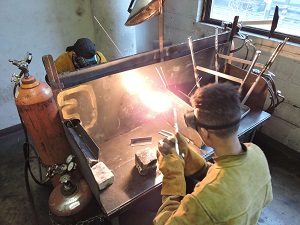
MIG welding is a type of arc welding that uses a continuous wire called an electrode. The electrode passes through the welding gun, enters the weld pool and joins two objects together. The welding operator also uses shielding gas that travels through the welding gun and protects against contamination.
MIG welding is one of the most common type of welding. It can be used in the automotive industry for repairing vehicle exhausts, as well as in the construction industry to create homes and buildings. Some advantages of MIG welding include:
- Higher electrode efficiency
- Minimal cleanup required
- Lower heat inputs
- Reduced welding fumes
TIG – Gas Tungsten Arc Welding (GTAW)
Like MIG welding, TIG welding also uses an electric arc. Welders use an electrode made of tungsten, one of the toughest metal materials found in nature. Tungsten does not dissolve or burn off. Welding can be done with the use of a filler metal or without a filler metal (this process is called fusion).
TIG welding also requires an external gas supply, such as argon or helium. Some advantages of TIG welding include:
- Ability to weld thin materials
- Clean, spatter-free welds
- High degree of purity
Stick – Shielded Metal Arc Welding (SMAW)
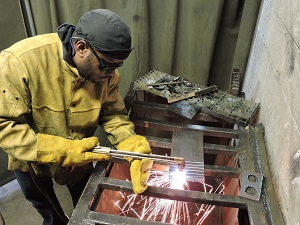
Weld operators use shielded metal arc welding, also called stick welding, for repairs and production. The type of welding uses a consumable and protected electrode, or stick. The stick softens and combines metals by heating them with an arc between a covered metal electrode and the base metal work piece. As the stick melts, its protective cover also melts and shields the weld area from oxygen and other gases that may be in the air.
Stick welding is portable and can be used in many different kinds of environments. Shielded metal arc welding is used in:
- Construction
- Maintenance and repair
- Underwater pipelines
- Industrial fabrication
Flux-cored – Flux-cored Arc Welding (FCAW)
Flux-cored arc welding is similar to MIG welding because both use equipment, continuous wire and power supplies. Like MIG welding, this type of arc welding can use a shielding gas. However, some weld operators choose not to use a shielding gas with flux-cored welding.
Weld operators unite a continuous electrode with a base metal. The electrode is a hollow tube filled with flux that is fed through the weld gun and into the weld pool. A flux shield offers protection against the wind when operators are welding outdoors. Some benefits can include:
- High productivity
- Excellent weld appearance
- Ideal for welding ferrous metals
Interested in Learning the Welding Trade?
Think welding could be a good fit for you? Take your interest to the next level by learning more about our Combination Welding Technology program at Apex Technical School. Explore the classes we offer or contact us with your questions today.
Next classes
Classes start every month
Day and evening classes at our Long Island City and Midtown Manhattan campuses. Talk to admissions to save your seat.
On this page
Apex Technical School
Ready to start your career?
Day and evening classes start throughout the year at both campuses.
Apply nowOr call 212-645-3300





Frequently Asked Questions
What is the difference between MIG and TIG welding?


Why is MIG welding so common in auto repair and construction?
What is stick welding used for?
How is flux-cored welding different from MIG welding?
Where can I learn MIG, TIG, stick and flux-cored welding in NYC?
Contact us
Fill out the form to get started.

