






Apex Insider
History of Woodworking Tools
Humans began fashioning and using tools as early as 2.6 million years ago. In the Stone Age, ancient peoples turned stones into basic tools such as hammers and axes, and they also leveraged sharp animal bones in more advanced toolmaking.
Key Highlights
Humans began fashioning and using tools as early as 2.6 million years ago. In the Stone Age, ancient peoples turned stones into basic tools such as hammers and axes, and they also leveraged sharp animal bones in more advanced toolmaking. These early tools were used for hunting and survival, but they paved the way for hand tools that helped early humans build shelters and other structures.
Some of the most important hand tools throughout history have included the knife, hammer, hand saw, and plane. Keep reading to learn the background of several of thesehand tools, which are still used today in the carpentry and building trade.
History of the Hammer
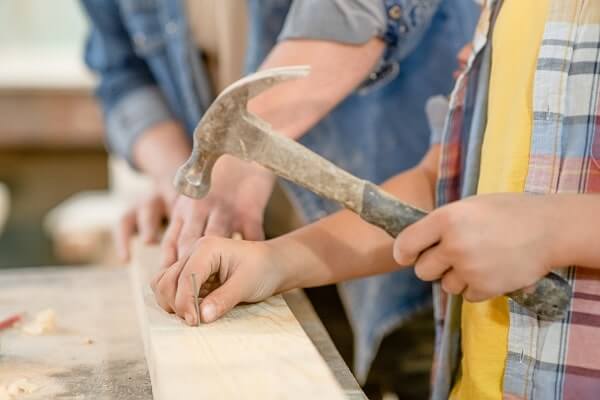
The hammer as we know it today consists of a handle and a head usually made of iron. But the earliest hammers began as only a granite hammer head, which was used to break stones into smaller pieces of flint. Over time, humans added the handle using a string of leather or vine for more control and precision.
Around 2000 to 1800 BC, hammers began to be made for specific jobs, such as blacksmithing, mining and carpentry. For centuries, tradesmen have improved very little upon the basic function of the hammer while also adjusting it for specialized uses such as soft-faced mallets, dead blow hammers and more. Hammers today often have a claw feature on the head, which carpenters and other tradespeople use to extract nails and remove boards.
It’s very common for most carpentry, construction or building jobs to have multiple types of hammers on site. In fact, students at Apex carry a hammer in their toolbox as part of the Construction & Building Skills program . This ancient and simple tool used for woodworking is still critical to the trades today.
Handsaws and Their Evolution
Experts aren’t sure when the first handsaw was invented. The knife paved the way for scissors, as well as for the handsaw. After all, a handsaw is a knife with sharp teeth on the edge that ancient humans used to cut materials like wood more efficiently. Egyptian texts show that a type of handsaw was used to help build the pyramids before 1500 BC. By the 17th century, handsaws were more readily available because blacksmiths could more easily produce them.
Specialty saws emerged in the 1800s, such as the compass saw, the ripsaw, the pitsaw and the cross-cut saw. Manufacturers produced saws that were used to help build structures. These saws had sloped, rounded edges and flat, rectangular edges. Today’s handsaws don’t look much different than the handsaws of the 1800s.
Now, many carpenters and construction workers use saws with plastic handles and removable blades that are both rust resistant and thicker than the saws hundreds of years ago.
Related:Construction History Through the Centuries
Planes for Woodworking & Building
The plane has existed for over 2,000 years and is a critical tool for craftsmen today. A plane, or a hand plane, is a tool for shaping wood using muscle power to force the cutting blade over the wood surface. Before the plane, early woodworkers likely used an adze, a stone and abrasive sand to roughly trim wood pieces.
Early examples of planes have been discovered in Rome, Britain and Germany, while the earliest known plane was excavated in Pompeii. Planes help carpenters and woodworkers remove rough surfaces and reduce a piece of wood down to the correct size for their structure. The main types of planes used in many woodshops today include:
- Block planes– Used for minor cutting, shaping, or leveling corners
- Smoothing planes– Used to remove fine shavings and create a smooth surface
- Jack planes– Used as a general, all-purpose plane for sizing and smoothing
- Jointer planes– Used to shave off large chunks and level surfaces
- Bevel-up planes– Used to vary the cutting angle by altering the bevel angle
- Joinery planes– Used to create joints
As the carpentry and building trade progresses, its tools will continue to evolve. Common tools today may be improved upon decades from now, to help construction workers, carpenters and builders become more efficient and precise in creating structures for customers.

Ready to step into the construction classroom and use carpentry tools in the shop at Apex? Learn more about the Construction & Building Skills program now.
Next classes
Classes start every month
Day and evening classes at our Long Island City and Midtown Manhattan campuses. Talk to admissions to save your seat.
On this page
Apex Technical School
Ready to start your career?
Day and evening classes start throughout the year at both campuses.
Apply nowOr call 212-645-3300









Frequently Asked Questions
When did humans start using tools?


How has the hammer changed over time?
When was the handsaw invented?
What is a hand plane used for in woodworking?
Where can I learn to use carpentry tools in New York City?
Contact us
Fill out the form to get started.

